
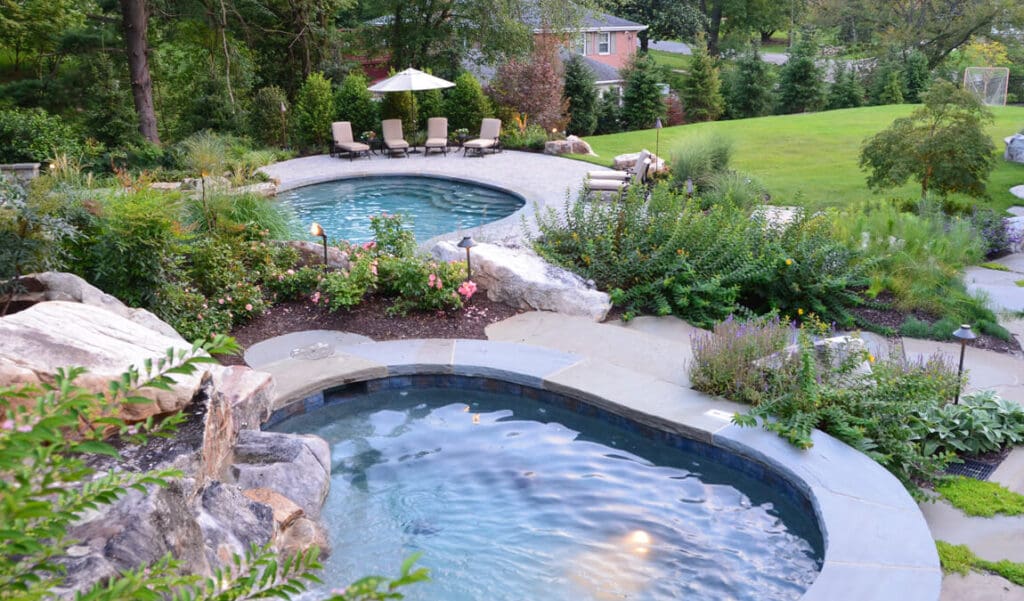
The aesthetic impact of every landscape design plan is rooted in practicality. Our landscape architects take cues from the architectural themes of the house and riff off of the natural features on the site.
Sometimes modifications are needed to achieve the desired effect or to correct conditions on the site such as poor drainage. Whether a lot of manipulation or a little is required to fulfill the design idea, we still want the end product to feel like it belongs.
The two design styles featured in this article couldn’t be more different, yet they both demonstrate these underlying principles. One of the designs represents a naturalistic style, the other a classic style landscape.
We hope that as we walk you through these two projects, your imagination will open up to the wealth of possibilities for transforming your backyard landscaping and creating outdoor living spaces that are tasteful expressions of your style. Also, we hope you will see the value of landscape design as an interpretive process aimed at creating outdoor environments that sit in harmony with the site and fulfill its hidden potential.
Case Study 1: A Landscape That Looks Like It “Just Happened”
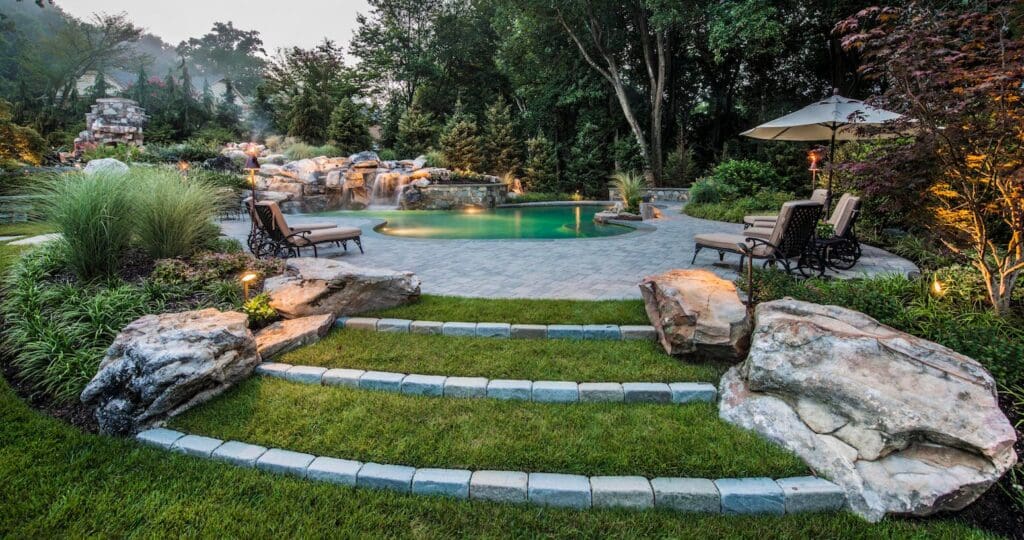
The naturalistic style of this backyard landscape design playfully blends constructed and unconstructed elements to achieve an overall natural look that includes qualities that are both crisp and unkempt.
The design follows the natural slope of the site—which drops about ten feet along the length of the house. The landscape architect’s plan establishes multiple outdoor rooms throughout changing elevations that are connected by gently stepped walking paths.
A Blank Slate
When the owners built their home, construction ended at the back door. As you can see in the upper right section of the BEFORE photo, a set of temporary wooden steps descends to a neglected landscape. Except for some gigantic hollies and a few scraggly trees at the perimeter of the property, it was a blank slate.
Click on the image to take manual control.
The homeowners wished for a backyard design that was “natural looking—as if you were walking into nature in a secluded area.” They wanted the landscape to
- unfold unselfconsciously
- to have soft edges and more curves in it than angles
- to have an unstructured look and feel
A Carefully Constructed Accident
The sloping lot was a challenge. The homeowners wanted a walk out from the basement level to the pool. The natural grade of the property allowed that. But the trick was to construct a way to the pool from the uphill side of the house—a ten-foot drop in elevation.
Many of the architects that we met with recommended a very sharp, defined concept, with a noticeable staircase and drop from the upper to lower levels of our back yard.
The Surrounds landscape design is all inviting pathways that traverse the grade. Long shallow steps and gracefully turning paths disguise elevation changes. There are no direct lines to any destination and the changes in grade are so gradual as to feel effortless.
It doesn’t feel like a drastic jump from the patio level to the pool level or from one area to the next.

Landscape architect Howard Cohen fashioned the site to reflect the clients’ love of nature. The unselfconscious appearance of the landscaping belies its structural complexity. Four patio areas connected by meandering walkways cleverly incorporate the changing elevations on the property. Changes of grade are subtle in some places, more dramatic in others.
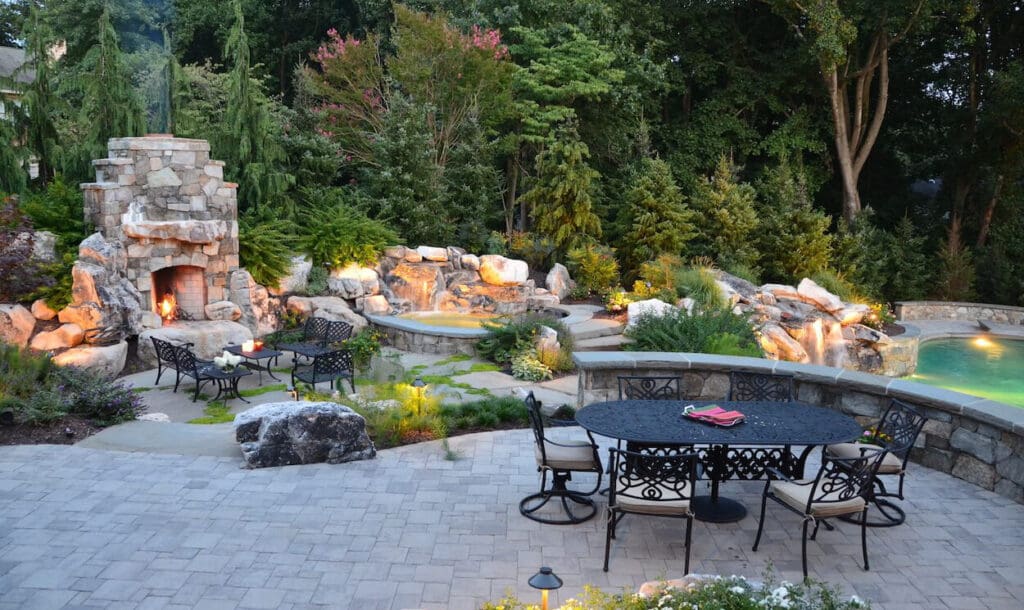
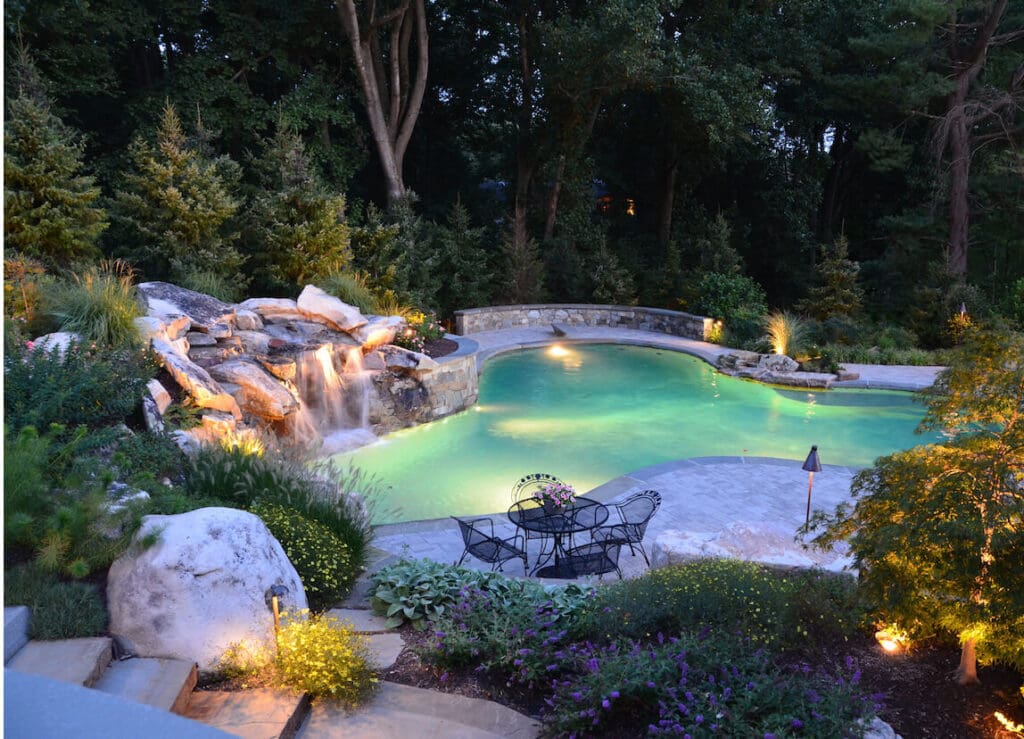
The design begins at the uppermost elevation with an outdoor kitchen and dining patio. A few steps down a gentle grade is an outdoor living room with fireplace and a nearby spa fed by a waterfall. A gently winding set of stone steps leads downhill to the swimming pool patio and another waterfall.
From there, shallow grass steps take you from pool deck to the play lawn beyond where the kids can kick a soccer ball around. The location of each use area takes advantage of sun patterns on the site. The open outdoor kitchen gets morning light but is protected from the hot afternoon sun by shadow cast from the house. The pool area gets full afternoon sun.
Moving and Shaping the Landscape
 An important item on the client’s wish list was to have a level playing field where the kids could toss a ball around or practice lacrosse. Cohen’s landscape design accomplished this by moving earth from other spots on the lot and using it to level an area just below the pool deck. Instead of a retaining wall to hold the flat area against the slope, the design employs buried boulders and plantings to ease the downhill direction gradually. So, even there, the landscape design plan affects a subtle, natural looking transition rather than something constructed that might call attention to itself.
Designed landscape features mimic the sort of rustic spontaneity you would find on a hiking trail in the mountains:
- Walkways naturally traverse grades and navigate around obstacles like hiking trails do.
- Constructed materials blend with unconstructed materials taken from the surroundings.
- Pavers and natural stone retaining walls abut raw uncut boulders.
- Plants and grasses spring from the cracks between stones.
Standing at the back door of the house, you see in the distance, a “mountainous” outdoor fireplace flanked by a charming waterfall that drops into a spa. This landscape is, of course, a fabrication that has been carefully constructed to achieve a convincing effect. It works. We accept it because the details feel right to us. Most importantly, the architect’s design revised and re-shaped the landscape in such a way as to fulfill the homeowners’ vision.
Would you like to immerse yourself in more landscaping ideas? Go to our portfolio to view more photos of this landscape design project.
Case Study 2: A Classic Style Backyard Design Brings Calm to a Chaotic Landscape
Intelligent Design
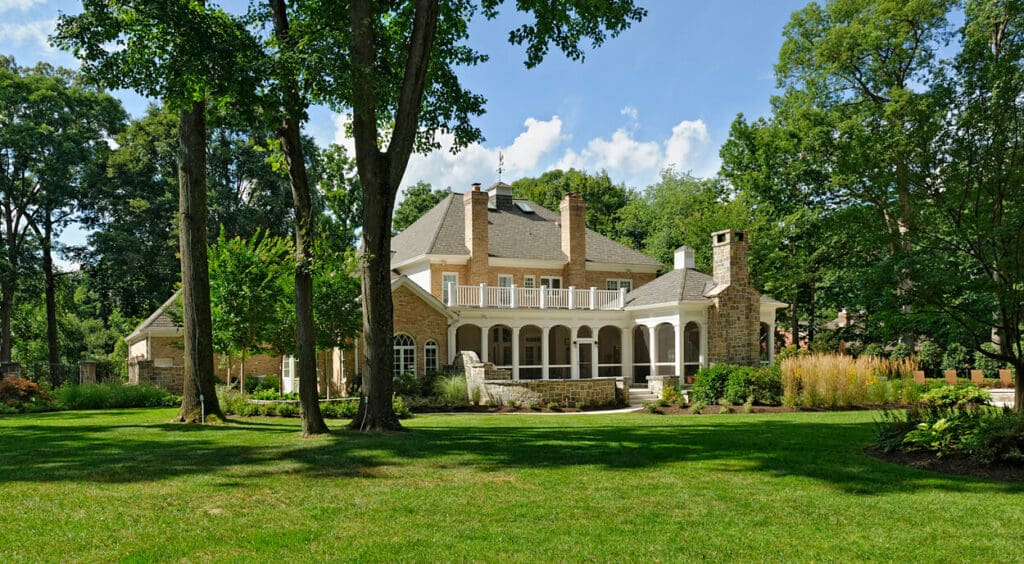
When landscape architect Howard Cohen first stepped into the Great Falls backyard of his new landscape design client, what he encountered was a mash-up of pathways, hardscaping, and structures that didn’t add up. It begged to be made right. “What I want from you, said the client, is a grand vision.”
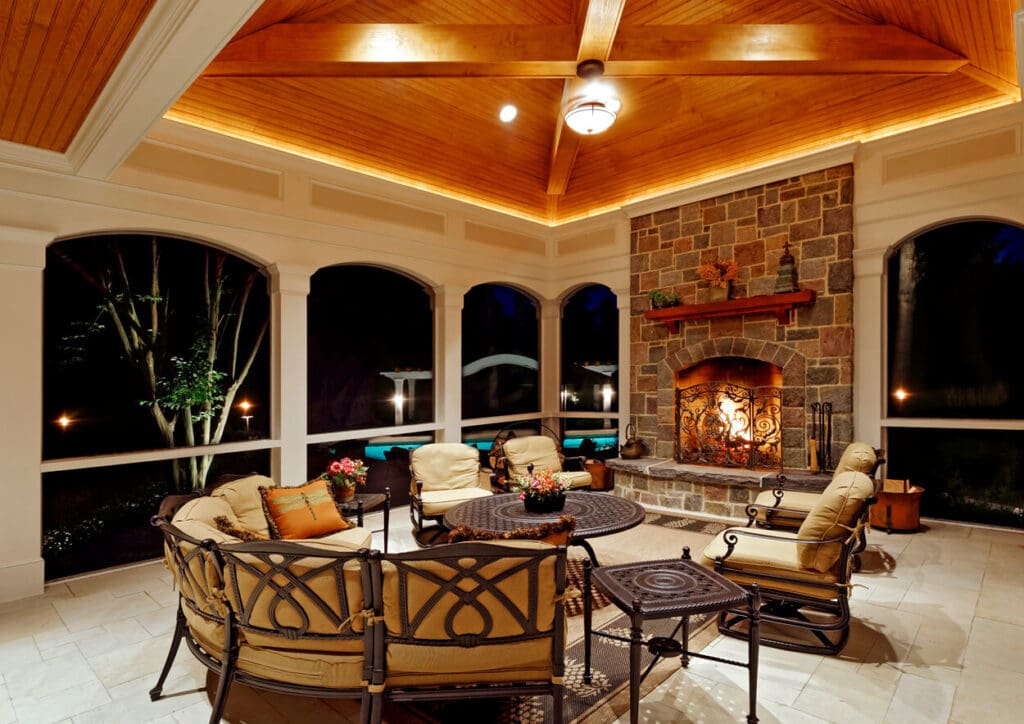
Cohen responded to that request with an ambitious and meticulous landscape design under-pinned by a strong thematic logic. At the center of his design is a show stopping screened porch and loggia anchored by a massive stone fireplace.
The Back Story
The clients chose their house somewhat quickly following an unexpected move to Virginia. Although they renovated the entire house without hesitation, they held off on making any large-scale improvements to the landscaping. It just didn’t make sense to them at the time because they didn’t initially feel a sense of long-term commitment to the place
Ten years later, all of that changed when they began a new chapter in their lives. They’d started planning for retirement:
We were looking for a destination property where we would have our retirement home that our children and their children would want to visit.
After looking around, the clients realized that they already had that destination property. It just needed a bit more something. As it turns out Cohen’s landscape designs, combined with the clients’ ambition, gave the place a LOT more something. Based on that vision, they made a commitment to do the work and stay in their house for many more years.
The Heart of the Landscape Design
Adding a screened porch to the backyard design was top of the list of features desired by the client. And the most important feature of that porch design would be a stone fireplace. It was a challenge to determine where to position this massive element. The client thought it should be on the side of the porch away from the yard for fear it would block views. The landscape architect convinced him to place it on the back side. He was right.
One side of the porch frames a broad view of the yard. The other side reveals the swimming pool and pergola beyond. The back wall, where the fireplace is, partially screens out the noise and activity at the swimming pool.
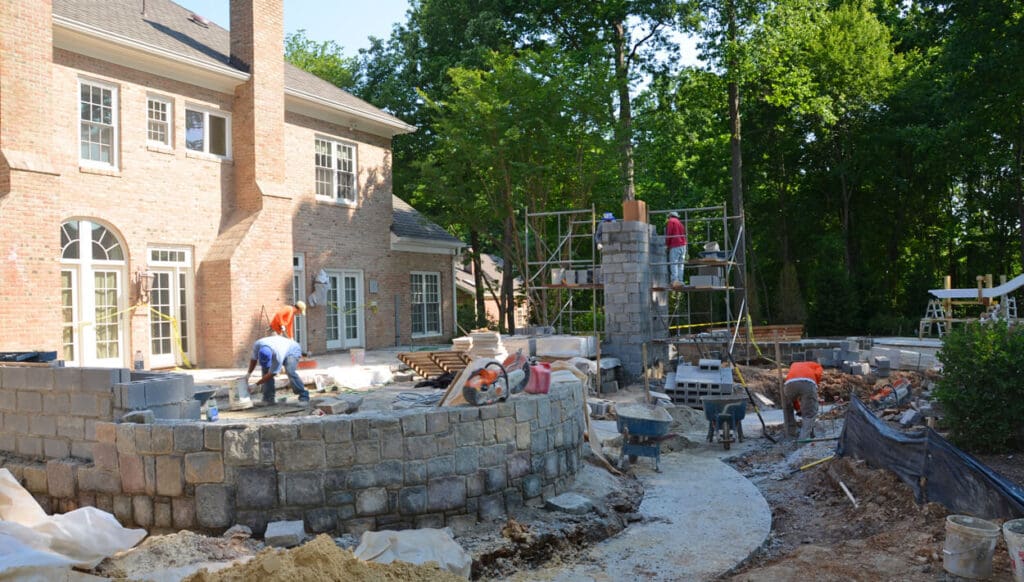
The porch sits on a raised terrace that steps easily out to the grill area, then on to the pool deck. The chimney is a major focal point on the porch structure and plays well from different viewpoints around the yard. It was so integral to the design that the fireplace, chimney and all the stonework was completed before carpenters began building the porch.
Creating an Arrival Experience
The intent of the new design was to “tidy up” a few existing features, create new ones and to superimpose thematic direction, shaping, and definition overall.
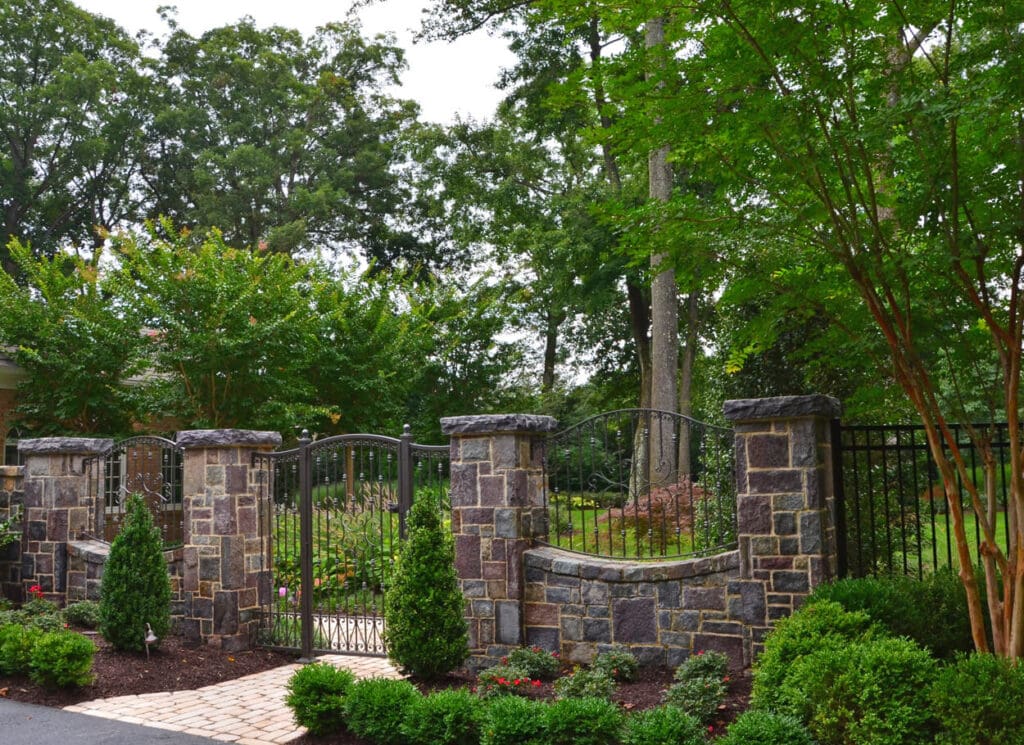
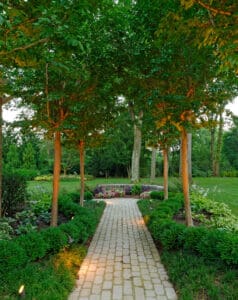
The first thing Cohen did was to create “an arrival experience.” His front yard design leads to an iron entry gate set between stone columns at the end of the driveway. Upon entering the back yard, the walkway leads to a circle where you turn and are led down toward another circle and walkway that brings you around to the rear terrace. The circles present inviting little areas to sit for a moment if you feel like it. Myrtles border the walkways.
Before implementation of the new landscape plan, the walkways throughout the yard were “uneventful” in that they didn’t create an experience of deliberately leading you from one point of interest to another.
Now the paths through the back yard take you on a journey. You step into a different world once you pass through that stunning garden gate. The redesigned walkways make sense of the landscape and how you move through it.
A Dash of Whimsy

One of the architect’s favorite features is something called a “folly.” The folly is a contrivance employed by landscape architects such as Frederick Law Olmsted—who designed Central Park in New York among other accomplishments. Follies were little buildings set out in a landscape that had no function. They were purely decorative. They were meant simply to be something to look at to create whimsy.
Cohen’s folly sits near the perimeter of the property. A large lawn area introduces some negative space to offset tree groupings, planting beds—and the folly.
Logical Relationships
There was a good-sized swimming pool on the existing site. But the pool deck was small. There was almost no room for furniture.
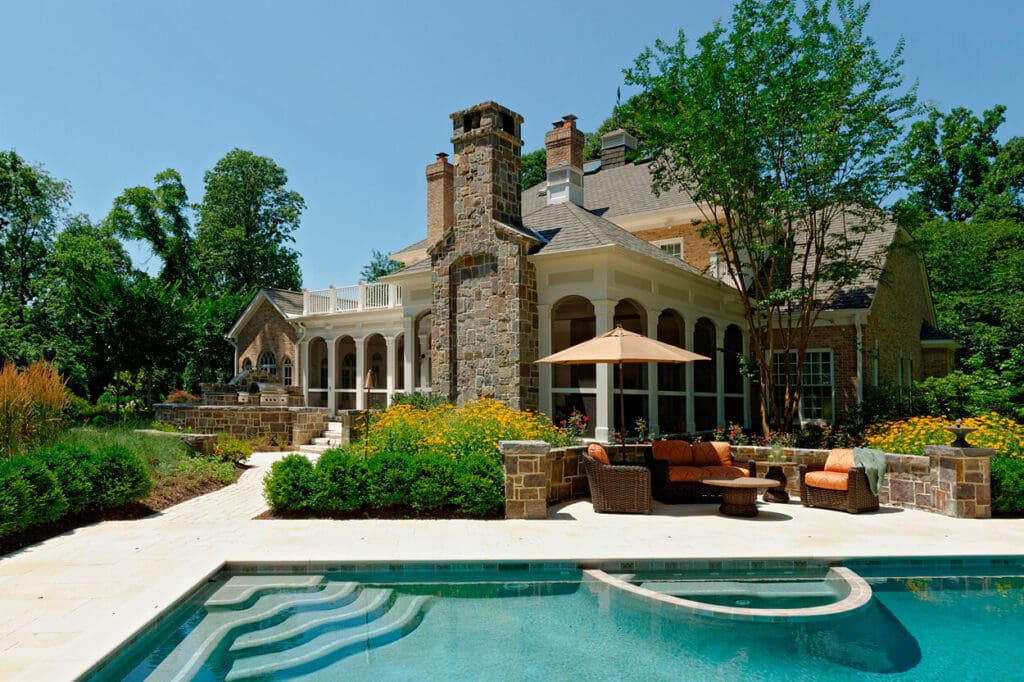
Cohen created a lounging area adjacent to the pool deck using low retaining walls backed by a raised bed of tall grasses and wildflowers. The walls provide definition, and the planting beds add a softening effect. The retaining walls also reference the porch chimney because of the matching stone used. This new area helps bridge the space between porch and pool bringing them into a logical relationship with each other.
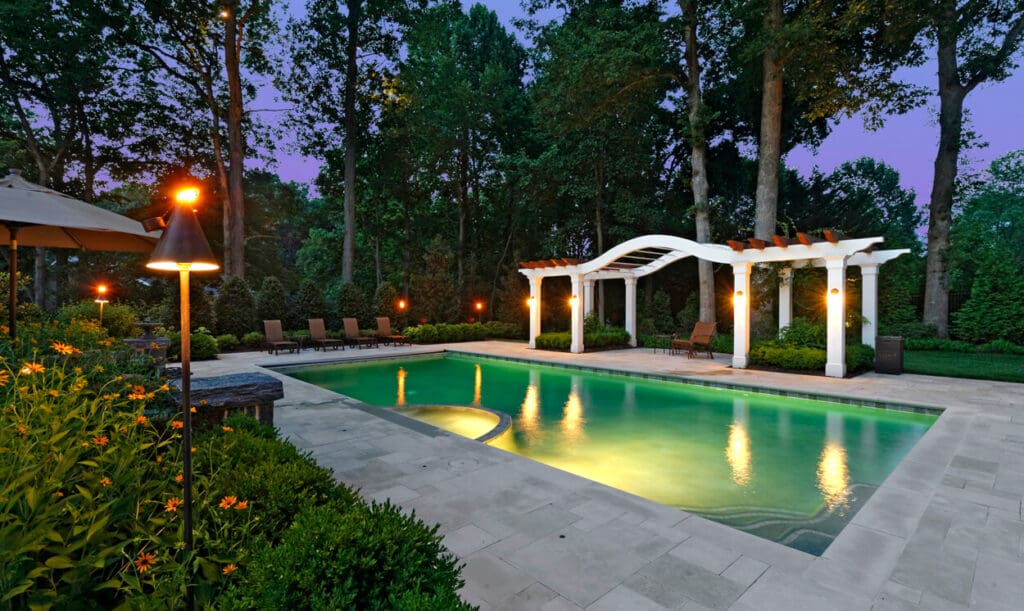
On the side of the pool opposite the lounge area, a new gracefully arcing pergola replaces its lackluster predecessor at the poolside dining area.
A Meaningful Place
It is interesting that a central feature of this landscape design was purely architectural. The implementation of the loggia and porch design improves the way the main house relates to the yard. The porch and loggia have become a vantage point for viewing and enjoying the scene. Relationships between the house and various areas of the backyard are now distinct and logically connect one space to the next.
Initially, the scale of this project was unimaginable to the homeowners, but time and a change in perspective made it exactly the right course for them to take. It is loaded with meaning for them. It is their permanent home, a welcoming place to be shared with children and grandchildren and good friends in the years ahead.
It’s absolutely a joy, and it improves with age. Our favorite time of year is spring. We look forward to all the things blooming, the perennials coming back. There is a real level of excitement….
 It’s absolutely a joy, and it improves with age. Our favorite time of year is spring. We look forward to all the things blooming, the perennials coming back. There is a real level of excitement….
We at Surrounds are grateful for opportunities to participate in making meaningful places for our clients to enjoy life. That’s the point. Otherwise, all this creativity would simply be an impressive extravagance. Contact one of our landscape architects if you’d like to talk about making the place where you live into a special place to stay.